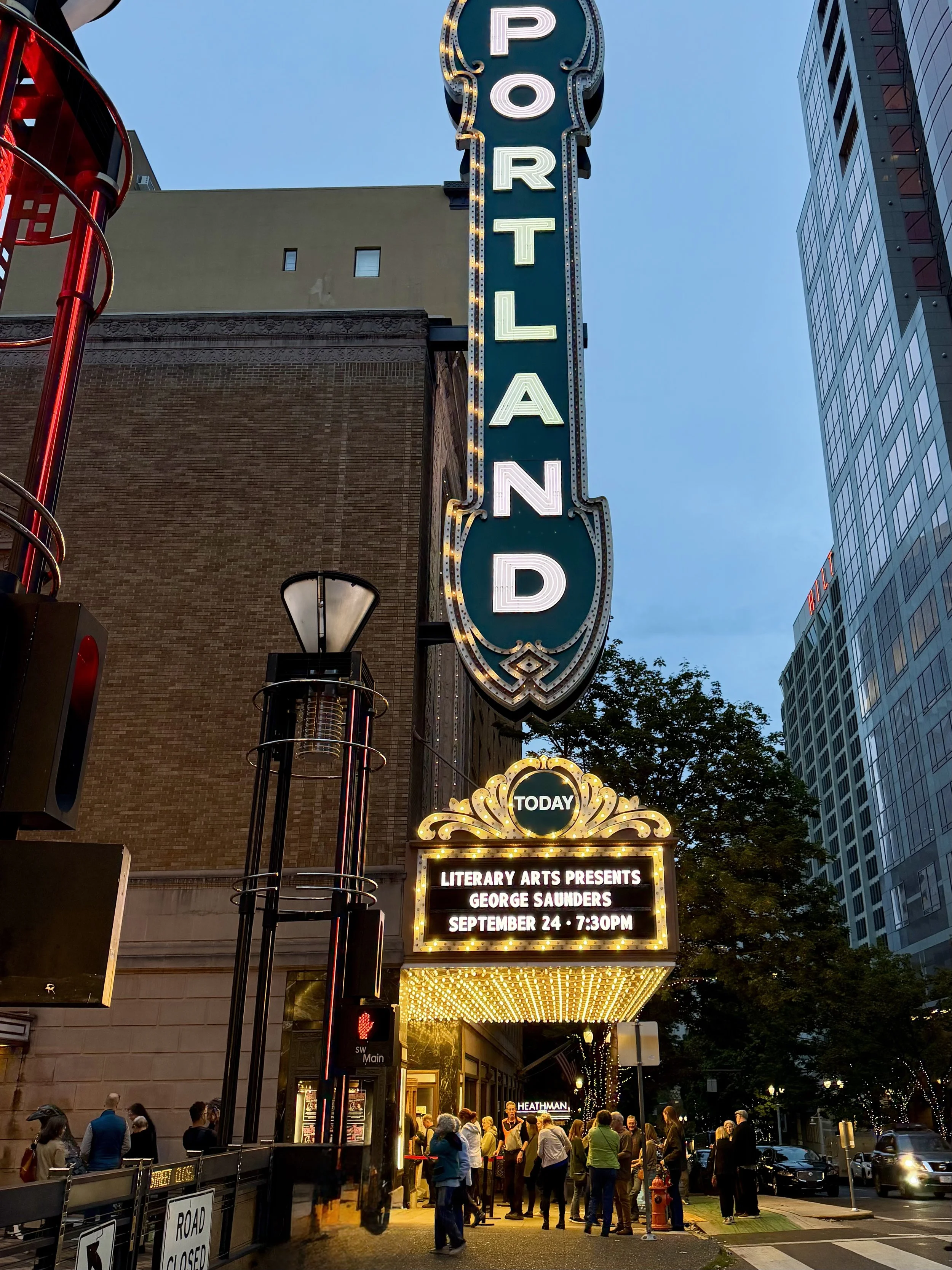
I recently heard George Saunders speak as part of the Portland Arts & Lectures series.
When I go to see an author or artist or celebrity I admire, I grit my teeth hoping I’ll like them as much as the person I’ve built up in my mind. I’m happy to report that figment of my imagination has nothing on the real guy! 💘
Saunders shared his unlikely literary beginnings as an academic ne’er-do-well and workaday engineer. He told us about his ambitions, foibles, and day-to-day practices as a writer and teacher.
Through it all, he elevated the acts of reading and writing without puffing himself up or downplaying his accomplishments. This is a man who’s devoted himself to using language as a way to connect across space, time and circumstance. He finds purpose, satisfaction and pride in a good day’s work and is clearly grateful he gets to do it.
Saunders concluded his talk by challenging us to “become better readers.” He urged us to commit to books we might not otherwise gravitate toward; to grapple with hard material and tolerate the discomfort of not getting (or liking) it right away. He reminded us that reading expands us only as much as we’re willing to let it open us to new things.
Of course, he’s right.
Upon hearing this I squirmed in my seat, chastened. Like many, my attention has taken a hit during these tech-soaked years. But that’s not the only reason my reading stamina has withered; it began to slip long before I carried an iPhone, when I was an exhausted new mother. In the many, many years since, I haven’t done enough to restore it.
I allowed myself to be buried by the unremitting ooze of “content” gushing from every channel, supercharged now by AI. But beneath my disillusionment was the regret that I’d let something precious slip away by degrees.
Words are units of connection. Language allows us to turn our private thoughts into sharable things. When we forget about language, we risk cutting ourselves off.
Feed words into the algorithmic and advertising machine and they’ll come out as raw, undifferentiated content, like ground meat. But feed words into one’s reading mind and they’ll interact and combine with memories and experiences, connecting them, reorienting them, fertilizing and seeding the ground with new insight.
One could dismiss Saunders’s concern about the erosion of reading as a professor’s lament or as fist-shaking at the young’uns. But he wasn’t fetishizing language or extolling the classics, and he didn’t promise art would save us. He simply urged us to recommit ourselves to reading; to strengthen our grip on language as a way back to ourselves and each other.
His call landed at just the right moment because my regret quickly evaporated and something else woke up in me, urgent and electric. I will! I’ll become a better reader! It suddenly felt as if nothing could be more important.
We’re drowning in spoken and written text. In this era of smartphones, podcasts, and the attention economy, it’s gotten to where we must block words out to tend to our nervous systems and even hear our own thoughts.
But what if we reversed the frame?
What if we fill up on words that nourish and expand us so there’s no time or appetite for slop?
What would happen if we all become better readers?