Kindness As Resistance
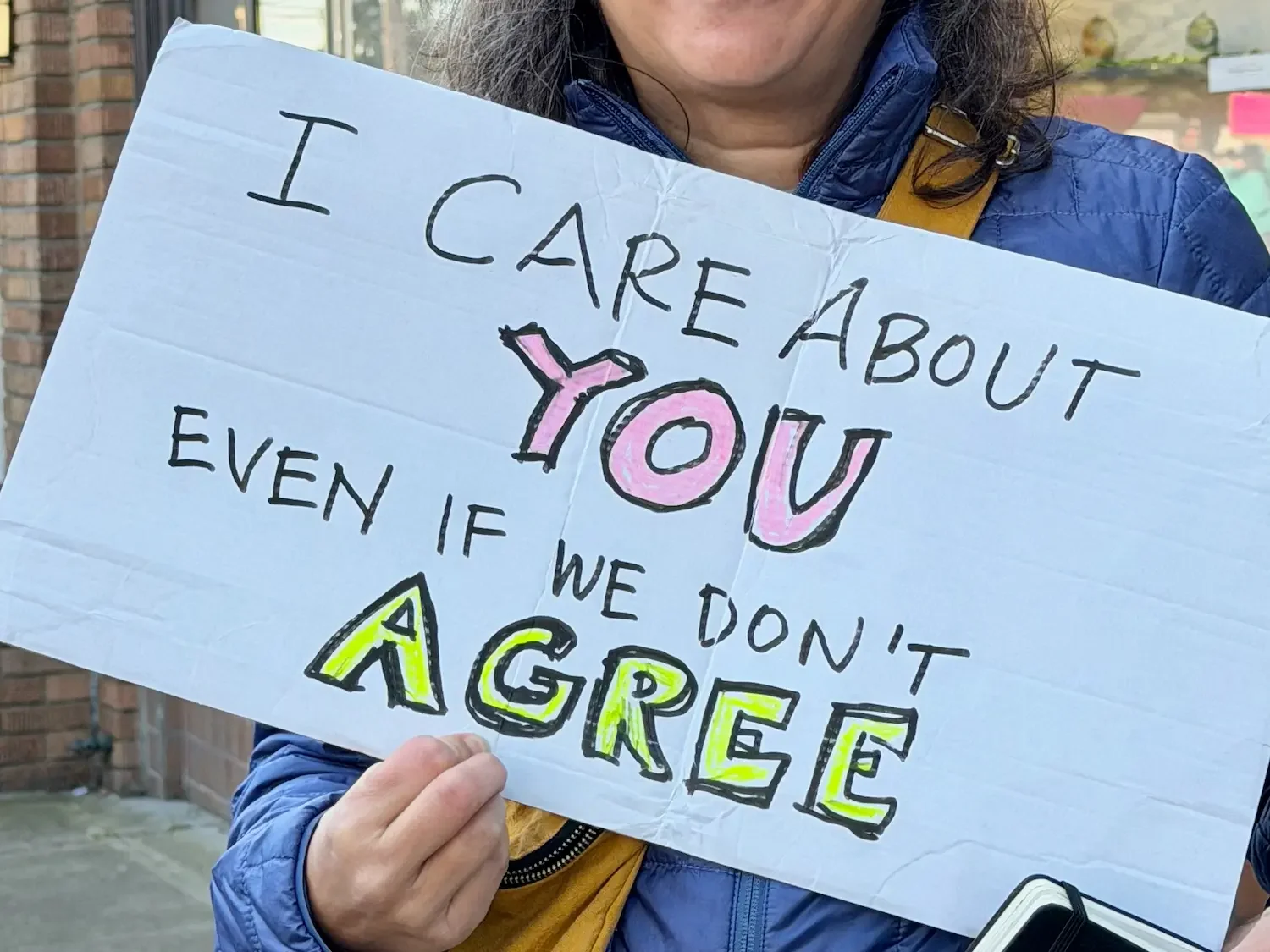
I made the sign minutes before I walked out the door.
The sense of foreboding has been building up for days. At first I thought it was a flare-up of COVID anxiety but I realized it was looming dread in the lead-up to the anniversary of the Capitol insurrection on January 6, 2021.
I’ll never forget that day. The kids and I were huddled on the couch, mouths agape, as we watched the attack on live TV. A violent mob, acting at the behest of the defeated president Donald Trump, stormed the Capitol in an attempt to subvert the election certification of the new president, Joe Biden.
We watched the end of America’s peaceful transfer of power.
I haven’t written much publicly about my 2016-2020 political activism.
I focused on local organizing and working with volunteers. Most of my writing at that time was private, in service of that community.
Briefly:
After the 2016 election, my friends and I were fearful about where our country was headed so we got involved. We formed a local community group and together we lobbied our representatives, peacefully protested, and got out the vote.
In other words, I respect people who use the political process to advocate for their beliefs. This includes people of integrity who hold different political views. I recognize that functioning democracy requires all of us.
What we all witnessed on January 6, 2021 may have started as protest, but it ended as a violent attack on the foundation of American democracy.
Democracy isn’t about agreement. It’s about engagement.
Meeting in the arena of ideas and policy, following an established set of rules to debate those ideas. It may be a discussion, it may be an argument, it may be a rhetorical brawl, but everyone follows the rule of law.
That’s the ideal. In practice, democracy is messy, inequitable, and, in some cases, broken. There’s dirty politics, dirty money, cronyism, self-dealing, and propaganda. There's apathy, ignorance, racism, and egotism. This has always been so.
American democracy was also founded by imperfect people who were creatures of their time, on a foundation of slavery, genocide and forced relocation of this land’s native inhabitants. To pretend this isn’t our history, but also to pretend this is our only history, is to dishonor those patriots -- past, present, and future -- who’ve fought to make it better.
The response to America's faulty democracy can’t be to throw our hands up -- if we do we risk losing our democracy altogether.
Surely "preserving American democracy,” perhaps not in this exact form, but as a container for our evolution, is something on which we can agree.
Surely we value our right to vote and have it fairly counted?
Surely we value a free press, the right to gather and speak up, the right to peacefully advocate for things we believe in?
Surely we want those rights and freedoms for our kids? For their kids?
America’s not perfect. American government is not going to be perfect this year, next year, or in 2024. But right now, it's sliding into something unfixable.
If we want American democracy to continue, imperfect though it is, we must be willing to love it more than we hate the other team.
I’m shocked that a sports-obsessed nation doesn’t get this. We must love baseball more than we hate the Red Sox (no offense, Boston, I’m trying to make a point).
(To repeat, I’m talking about engaging with people who disagree with my position but agree on the rules of engagement. I am NOT talking about legitimizing people who are trying to break the system with propaganda, or to disenfranchise or harm me or other groups of people.)
The thing is, we’re exhausted. We’re grief-stricken. We’re struggling to make ends meet, send our kids to school, and keep our parents safe.
We're exhausted, but we're not powerless.
There are things we can do right now to reinforce our democracy:
Practice kindness. Bonus: it’s a powerful tactic.
Differentiate between people who hold different political opinions and those trying to disenfranchise, misinform or actively injure people. Engage with the former; oppose the latter.
Take a breath before popping off. Vitriol and cynicism halt progress.
Use your platform wisely. Stop amplifying the most outrageous people and messages.
Persist. Keep coming back. Be stubbornly open.
These things may seem idealistic and overly simple, but they're foundational. These are the building blocks of communication, and we must use them to fortify our democratic system against those attempting to break it.
Because once it's broken, it's done.
Talk to people. Engage. Discern. You don’t have to become a political expert. But you have a responsibility to take action. We all do as participants in a democracy. We don't have to do these things perfectly, but we have to start somewhere.
Look to your local civic organizations for guidance. Or just talk to your family, friends, and co-workers. Make art that communicates your values.
For more guidance, read The Lightmaker's Manifesto by my friend Karen Walrond. This book will change your definition of activism.
If you’re a Republican voter who fears for American democracy, you’ve got it hard. You may feel conflicted and have skeptical friends. The Lightmaker's Manifesto is non-partisan and shows what quiet- and even silent activism can look like. If you prefer, listen to the audiobook -- Karen's grounded, calming voice will help you stay grounded.
You don't have to do this alone; you multiply your impact when you join up with others. Gather friends in a “Democracy Club” and discuss the book together. For more about Democracy Clubs, read my op-ed in the Oregonian.
Let’s love our democracy enough to stand up for it.